It's 2am, your partner rolls over to grab water, and you're wide awake staring at the ceiling. If that sounds familiar, you already know the real problem isn't romance, it's the mattress. Finding the best sprung mattress for couples isn't about picking whatever's on the showroom's biggest sign, it's about solving specific, annoying, very real problems: one of you moves, one of you runs hot, one of you likes it firm and the other likes it soft, and somehow you both have to sleep on the same 5x6.5ft surface for the next eight years.
I've spent a lot of time in mattress showrooms, in delivery vans, and in conversations with couples who bought the wrong bed and regretted it within a month. This guide skips the generic "top 10 mattresses" format. Instead, it walks through exactly what to check, why it matters for two people rather than one, and how to test it properly before you hand over your card.
Key Takeaways
- Motion isolation and edge support matter more for couples than almost anyone tells you.
- Spring count is a marketing number, not a quality guarantee.
- There's no single "correct" firmness, it depends on sleeping position and body weight.
- Pocket springs generally outperform open coils for reducing partner disturbance.
- Hybrids add cushioning but can trade away some traditional bounce and airflow.
- The best sprung mattress for couples is the one that scores well for both of you, not just one.
Table of Contents
- What Makes a Sprung Mattress Good for Couples?
- In My Experience, Motion Transfer Is One of the Biggest Deal-Breakers
- What Most People Get Wrong About Spring Count
- Couples Choose the Wrong Firmness More Often Than You'd Think
- Most People Ignore This Part: Edge Support Matters More for Couples
- Pocket Sprung vs Open-Coil: Which Is Better for Two People?
- Pocket Sprung vs Hybrid Mattress for Couples
- This Is Where Things Get Real: Different Body Weights
- What If One of You Sleeps Hot?
- Honestly, I Made This Mistake Too: Choosing by Price Alone
- The Best Sprung Mattress for Couples Depends on Your Situation
- King vs Super King: How Much Space Do Couples Really Need?
- The Couple's Mattress Buying Scorecard
- Comparison Table: Pocket Sprung vs Open Coil vs Hybrid
- Pros and Cons of Sprung Mattresses for Couples
- How to Compare Two Sprung Mattresses Before Buying
- Mistakes Beginners Make When Buying a Couples Mattress
- A Step-by-Step Guide to Choosing the Best Sprung Mattress for Couples
- AI Tools and Mobile Apps Can Help Couples Compare Mattresses
- Automation in Mattress Research: A Smarter Way to Shortlist
- Featured Snippet: Quick Answers for Couples
- FAQ: Questions Couples Ask Before Buying
- How This Guide Was Put Together
- Final Decision Framework: Which Sprung Mattress Should a Couple Choose?
What Makes a Sprung Mattress Good for Couples?
The best sprung mattress for couples should minimise partner disturbance while providing strong edge support, balanced comfort, adequate pressure relief and consistent support for both sleepers. That's the short version. The longer version is that "couples-friendly" isn't one feature, it's six working together.
Here are the six core buying criteria that actually decide whether a sprung mattress for couples works or doesn't:
- Motion isolation — how much movement travels across the mattress when one person shifts.
- Edge support — whether the perimeter holds firm when you sit or sleep near it.
- Pressure relief — how well the surface cushions shoulders, hips and lower back.
- Individual support — whether the spine stays aligned regardless of body weight.
- Temperature regulation — how well the mattress avoids trapping heat under two bodies.
- Durability — how long the mattress keeps its shape under double the nightly load.
A mattress that feels brilliant to one person in a showroom can still be a poor choice for a couple, because it was only tested by one person's weight, position and habits. Add a second sleeper and the springs compress differently, the comfort layers respond differently, and the "perfect" feel can shift entirely. That's why there's no single firmness level that suits every couple, no matter what a shop assistant tells you on a Saturday afternoon.
The 5 Features Couples Should Prioritise
- Motion isolation
- Edge support
- Correct firmness for both sleepers
- Cooling and airflow
- Support across different body types
Why Couples Need Different Mattress Criteria Than Solo Sleepers
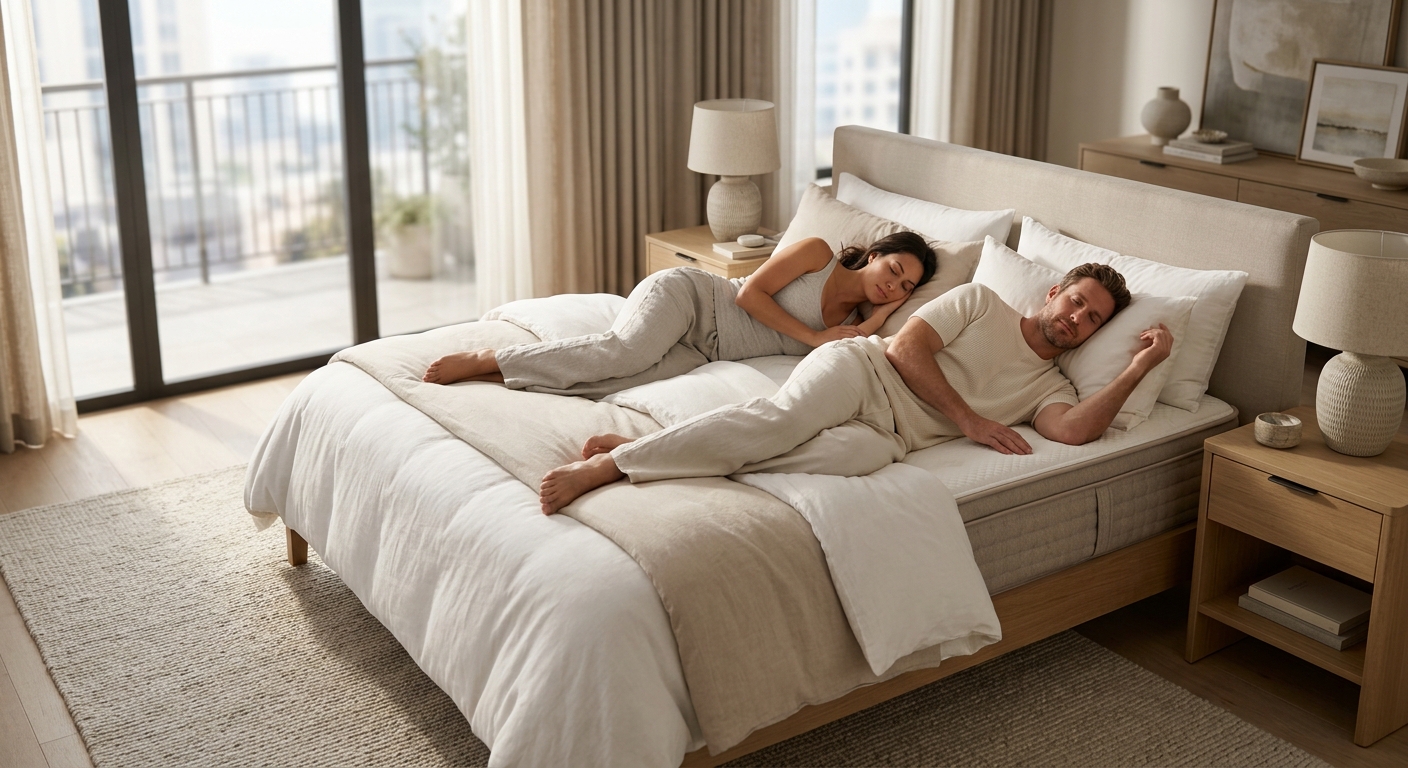
Two people create two separate pressure points instead of one, which changes how the springs and comfort layers respond across the whole surface. Movement becomes far more noticeable, because you're not just feeling your own shifting, you're feeling theirs too.
The usable sleeping surface matters more as well, since a mattress that feels spacious solo can feel cramped once someone's elbow ends up in your side. Weight distribution changes spring response, and different sleeping positions between partners can create genuinely conflicting comfort requirements that a solo-sleeper mattress was never designed to solve.
In My Experience, Motion Transfer Is One of the Biggest Deal-Breakers
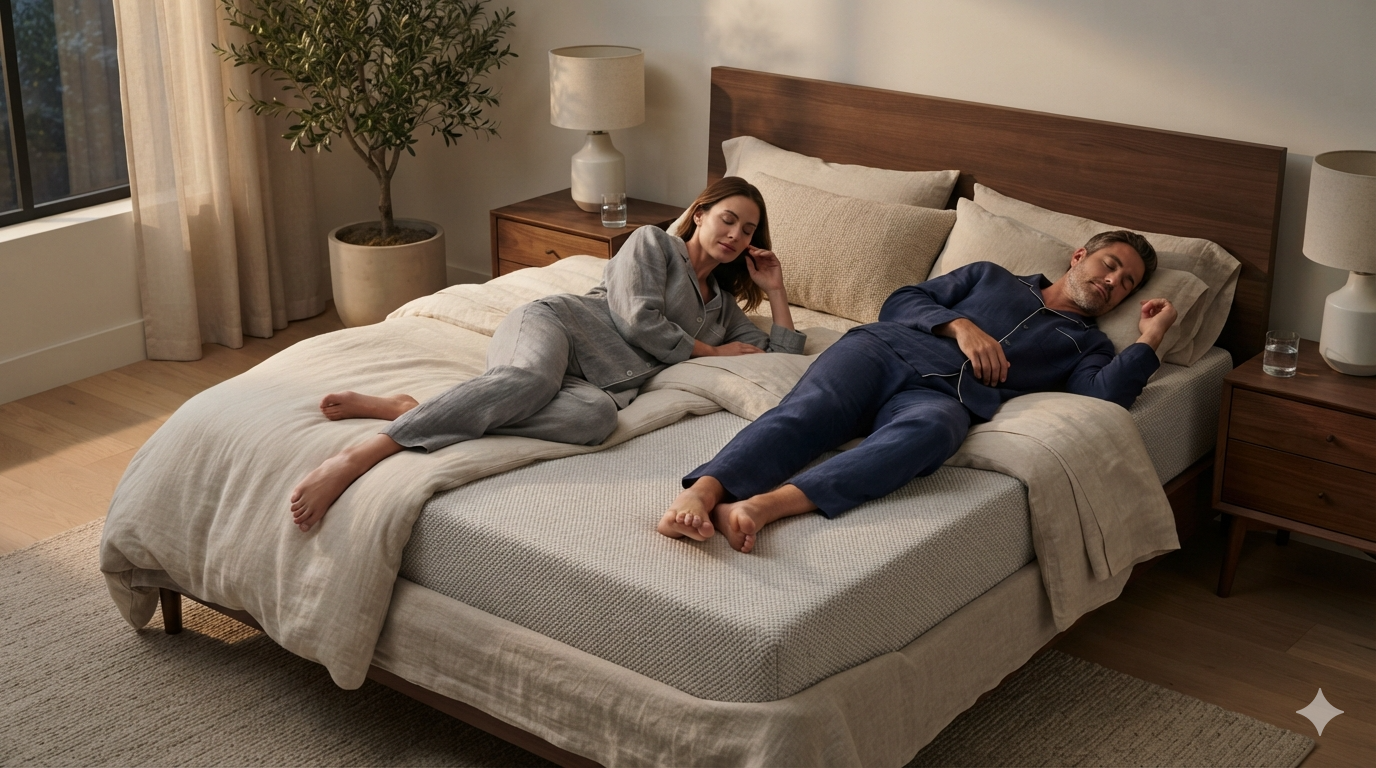
In my experience, motion transfer is the single most common reason couples come back into a showroom within weeks of buying. Not firmness, not price, motion transfer. If your partner works shifts, gets up for the bathroom twice a night, or just tosses and turns, you'll feel every one of those movements unless the mattress is built to isolate them.
Picture this: you finally drift off, and then your partner turns over, or gets out of bed for water, or sits on the edge to put socks on. On a poor-quality mattress, that whole event ripples across the surface and wakes you up. On a well-built one, you barely notice. That difference alone can be the deciding factor in whether a sprung mattress for couples actually earns its keep.
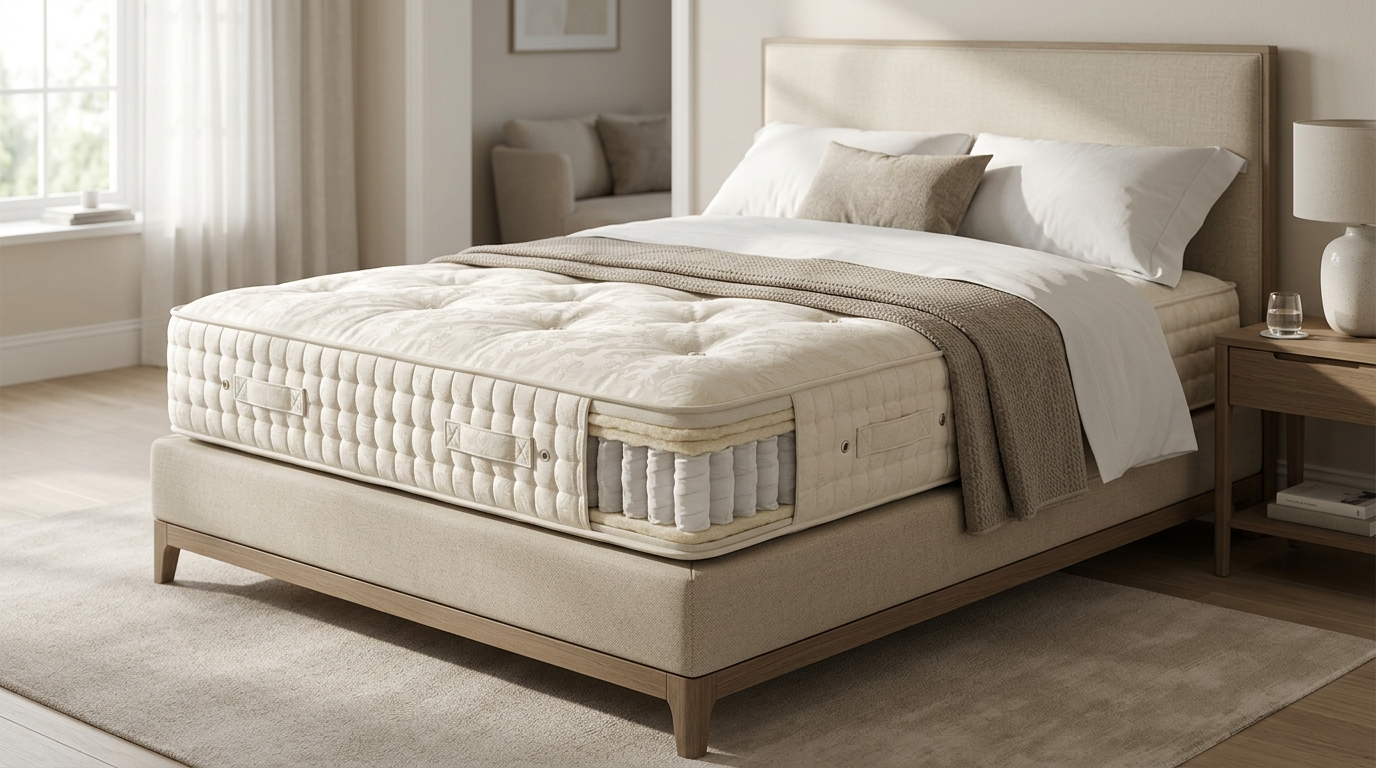
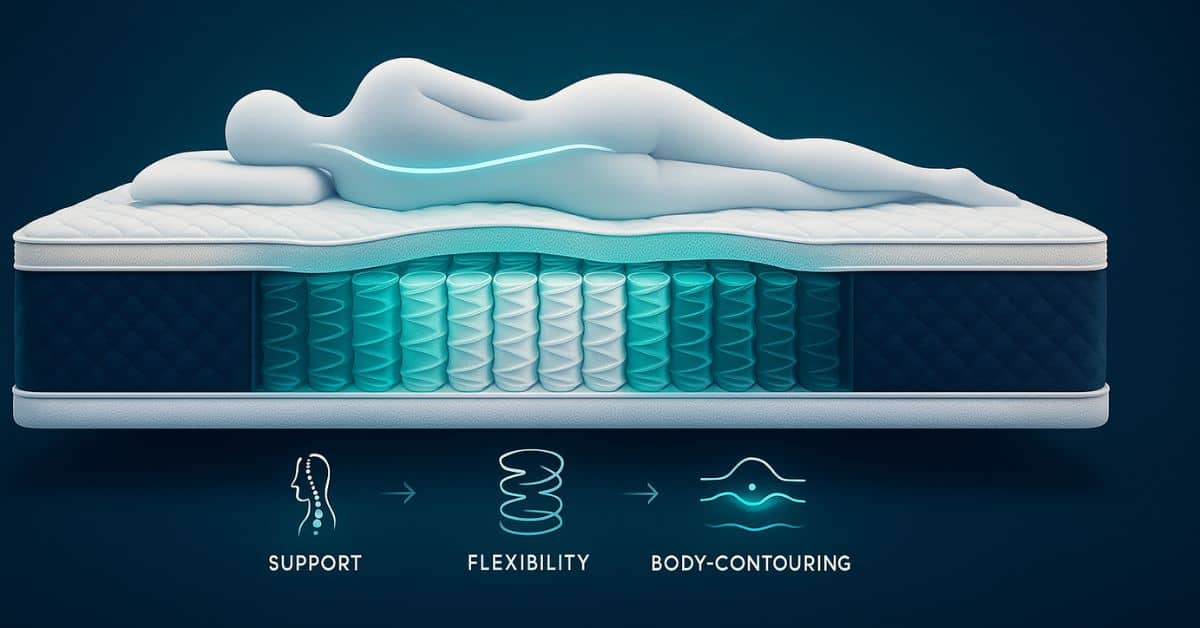
Individually wrapped pocket springs help here because each coil moves independently, rather than pulling on its neighbours. That said, motion isolation isn't the same thing as responsiveness or bounce. A mattress can isolate movement well and still feel lively and supportive when you change position yourself, the two properties aren't opposites, they're just measuring different things. This is exactly why couples should physically test movement in-store rather than trusting a spec sheet alone.
How Pocket Springs Reduce Partner Disturbance
Each coil in a pocket sprung mattress sits in its own fabric pocket, so it compresses on its own without dragging on the springs beside it. Compare that with interconnected open-coil systems, where one spring's movement pulls on the whole network, sending motion rippling outward in every direction.
It's worth remembering that comfort layers also shape how much movement you feel. A dense, well-built foam or fibre layer sitting on top of good springs can absorb extra motion, while a thin, poor-quality layer adds almost nothing. Spring construction alone doesn't determine motion isolation, the whole build does.
The Simple Partner-Disturbance Test
This one takes five minutes and tells you more than any brochure. Try it together in the showroom, and again at home during a trial period if you get one:
- One person lies completely still on their side of the mattress.
- The other gets in and out of bed a few times.
- Turn over several times, as you naturally would overnight.
- Sit on the edge of the mattress.
- Compare notes on how much movement actually reached the still partner.
If you can, repeat the test at night once the mattress is home. Movement feels different when you're relaxed and half-asleep than when you're stood in a bright showroom fully alert.
What Most People Get Wrong About Spring Count
What most people get wrong is assuming more springs automatically means a better mattress. It's an easy trap, because spring count is the one number every retailer prints in bold. But spring quality, coil configuration, gauge, zoning and the comfort layers on top all matter just as much, sometimes more.
There's also an honesty problem in the industry: some manufacturers count total springs across the whole mattress, others count per individual sleeping area, and a few use different measurement methods entirely. A 2,000-spring king size mattress split between two sleepers isn't automatically better than a well-zoned 1,200-spring mattress with proper reinforcement where it counts.
Spring Count vs Spring Quality
- Number of springs
- Spring type (pocket, open-coil, mini pocket, micro-coil)
- Coil design and shape
- Spring tension
- Coil gauge (thickness of the wire)
- Zoning (firmer support under hips and shoulders, softer elsewhere)
- Comfort materials layered on top
- Edge reinforcement
Does a Higher Spring Count Mean Better for Couples?
A higher spring count can genuinely help, particularly with motion isolation, since more individually wrapped coils generally means finer, more localised movement. But it should never be the only number you look at. Ask what construction, gauge and zoning sit behind that headline figure before assuming it settles the decision.
I've Seen This Happen Many Times: Couples Choose the Wrong Firmness
I've seen this happen many times: one partner wants a plush, sink-in feel and the other wants something firm enough to bounce a coin off, so they meet in the middle and end up with a mattress that satisfies neither of them. Compromise firmness isn't the same as correct firmness, and "firm" isn't automatically the same thing as "supportive".
A mattress can be firm and still let your hips sag out of alignment, or soft and still keep your spine properly supported, it depends on the internal structure, not just how it feels when you press your palm on it. Sleeping position changes what you need, and body weight changes how firm a mattress actually feels once you're lying on it, which is why medium-firm isn't automatically the right answer for every couple, even though it's the safest-sounding option in a showroom.
Best Firmness for Couples Who Sleep on Their Sides
Side sleepers need pressure relief around the shoulders and hips above almost anything else. Look for enough cushioning to let those points sink slightly, and avoid mattresses that are so firm they create pressure points rather than support.
Best Firmness for Back Sleepers
Back sleepers generally do best with balanced, consistent support that keeps the spine in a neutral line. Watch for excessive sinkage around the lower back, which is one of the most common causes of morning stiffness. If back discomfort is already a factor for either of you, it's worth reading our guide on choosing a pocket sprung mattress for back pain alongside this one.
Best Firmness for Couples With Different Sleeping Positions
When one of you sleeps on your side and the other on your back, look for a responsive spring system with comfort layers that can adapt to both. Sometimes the answer isn't a different mattress at all, a well-chosen topper on one side can bridge the gap without forcing either of you to compromise on the base mattress.
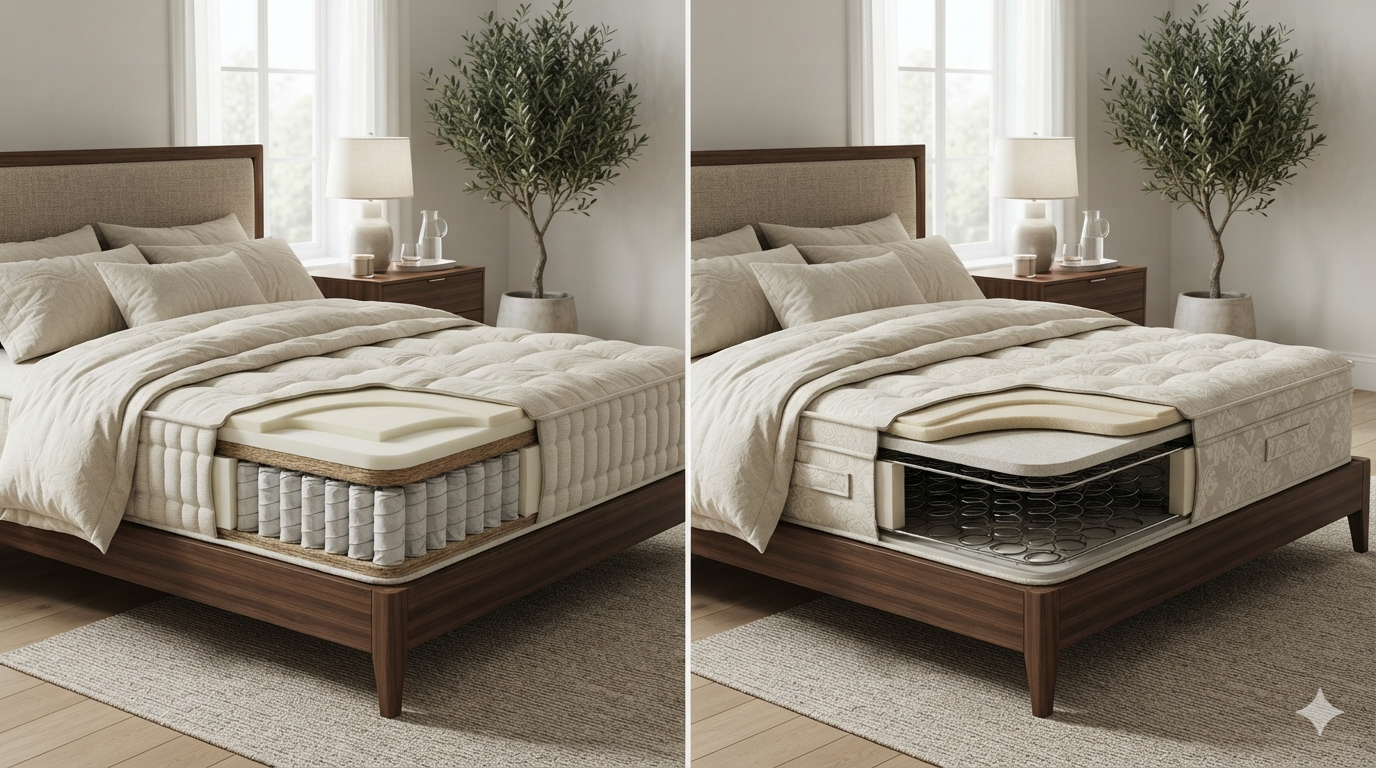
Most People Ignore This Part: Edge Support Matters More for Couples
Most people ignore this part entirely, but strong edge support effectively gives you more usable bed. If the perimeter collapses when you sit down to put your shoes on, or when you sleep close to your side of the bed, you both end up gravitating toward the centre, which brings you right back to feeling every movement your partner makes.
Weak edges also make getting in and out of bed feel unstable, and over time they can accelerate sagging across the whole mattress. Reinforced perimeter systems, whether that's a firmer border of springs or a dedicated foam encasement, keep the sleeping surface usable right to the edge.
How to Test Edge Support
- Sit right on the edge, as if getting dressed.
- Lie down near the edge, not in the centre.
- Change position while lying there.
- Compare how much the edge compresses and whether it feels stable.
- Test both sides, not just one, since construction can occasionally differ slightly between sides.
Pocket Sprung vs Open-Coil: Which Is Better for Two People?
Pocket sprung and open-coil are the two classic sprung mattress constructions, and for couples specifically, they don't perform the same way at all. It's worth understanding the difference before you get pulled into showroom sales language.
Pocket Sprung Mattress for Couples
- Each spring moves independently, improving motion control.
- Support adapts more precisely to each sleeper's shape and weight.
- Generally a stronger option when partners have different sleeping patterns.
Traditional Open-Coil Mattress for Couples
- Usually more affordable upfront.
- Springs are interconnected, so movement travels further across the surface.
- Partner disturbance is typically higher.
- Still a sensible choice for couples on a tighter budget who both sleep soundly and rarely shift positions overnight.
Pocket Sprung vs Hybrid Mattress for Couples
A hybrid mattress pairs a pocket spring core with a foam or latex comfort layer on top, rather than the thinner quilted layer you'd find on a traditional sprung mattress. That's the whole distinction, "hybrid" describes a construction, not automatically a higher tier of quality. If you want a deeper breakdown of how foam and springs behave differently, our pocket sprung vs memory foam comparison covers that in more depth.
When a Pocket Sprung Mattress Makes More Sense
- You want a traditional spring feel with noticeable bounce.
- Airflow and breathability are a priority.
- You prefer responsive support rather than a slow-sinking feel.
- Neither of you wants a heavily foam-based surface.
When a Hybrid May Be Better
- You want extra cushioning on top of spring support.
- Pressure relief is a bigger priority than pure bounce.
- One of you likes some foam-like motion absorption without going fully memory foam.
- You'd prefer a softer, less traditional spring feel underfoot.
This Is Where Things Get Real: What If You Have Different Body Weights?
This is where things get real for a lot of couples: two people of noticeably different weights can lie on the exact same mattress and feel two completely different products. Springs compress more under more weight, which changes how supportive and how firm the mattress feels on each side.
Heavier sleepers generally need stronger, higher-tension support to avoid excessive sinkage, while lighter sleepers can find that same firm mattress feels unexpectedly hard, since their weight isn't compressing the springs enough to reach the softer comfort layer underneath.
Mattress Choice for Lightweight + Heavier Couples
- Look for balanced support that performs consistently across a range of weights.
- Consider zoned spring systems, which adjust firmness by body region rather than uniformly.
- Prioritise stronger perimeter support if either partner sits or sleeps near the edge often.
- Avoid choosing a mattress based solely on one partner's weight and preference, it needs to work for both of you.
What If One of You Sleeps Hot?
Sprung mattresses generally have an airflow advantage over dense, all-foam constructions, simply because open space around the coils lets heat move rather than get trapped. Thick, heavily cushioned comfort layers can work against that advantage though, since foam holds heat closer to the body than a more open spring structure does.
Breathable covers and natural fillings, like wool or cotton blends, can help manage moisture and temperature further. It's worth being realistic here, no mattress will completely eliminate overheating on its own, bedding choice and bedroom temperature still play a real part.
Best Sprung Mattress Features for Hot-Sleeping Couples
- Breathable spring core with open construction
- Good overall airflow through the mattress
- Moisture-managing comfort materials
- Breathable, natural-fibre cover
- Bedding suited to warmer sleep
- A bedroom temperature that isn't working against you
Honestly, I Made This Mistake Too: Choosing a Mattress by Price Alone
Honestly, I made this mistake too, early on I assumed the most expensive mattress in the showroom had to be the best one, and separately assumed the cheapest was "good enough" simply because it looked the part. Neither assumption held up. Cheapest rarely means best value, and a high price tag doesn't automatically guarantee it's right for two sleepers.
Instead of judging by price alone, look at the whole picture: construction, materials, warranty length, trial period, expected lifespan, the level of support offered, and specifically how it performs for couples rather than solo sleepers.
How to Judge Value Instead of Price
- Work out cost per expected year of use, not just the sticker price.
- Assess the quality of construction, not the marketing copy around it.
- Read the actual warranty terms, not just the headline number of years.
- Check return and trial conditions before you commit.
- Judge suitability for both sleepers, not just the one doing the shopping.

The Best Sprung Mattress for Couples Depends on Your Situation
There's no single winner here, because the best sprung mattress for couples genuinely depends on how you both sleep. Here's how to match the mattress to your specific situation.
Best for Couples With a Restless Sleeper
If one of you moves a lot overnight, this is arguably the scenario where the best mattress for restless couples has to prioritise motion isolation above everything else. Look for individually wrapped pocket springs paired with a well-built comfort layer, and run the partner-disturbance test before you buy.
Best for Couples With Different Firmness Preferences
Aim for a balanced medium or medium-firm construction as your starting point. A topper on one side can fine-tune the feel without needing two separate mattresses, and in some cases a split configuration, two mattresses of different firmness joined under one cover, genuinely solves this better than any single compromise product.
Best for Side-Sleeping Couples
Prioritise pressure relief, responsive support, and enough cushioning around the shoulders and hips to avoid pressure points building up overnight.
Best for Couples Who Sleep on Their Backs
Consistent support and proper spinal alignment matter most here, with moderate rather than heavy cushioning.
Best for Couples Who Move Around During Sleep
Balance responsiveness with motion isolation. If partner disturbance is a real concern, be cautious of overly bouncy constructions, even though bounce feels good for five minutes in a showroom.
Best for Couples Who Want Strong Edge Support
Look specifically for a reinforced perimeter and a genuinely stable edge construction, and consider sizing up, since larger mattress sizes generally come with a proportionally larger supported edge.
King vs Super King: How Much Space Do Couples Really Need?
Mattress size affects comfort just as much as construction does. More usable surface means less accidental contact overnight, which matters even more if one partner is a restless sleeper. Before upgrading anything else, compare your usable sleeping space against your actual bedroom dimensions, there's no benefit to a super king that leaves you unable to open the wardrobe door.
Sometimes upgrading size delivers more comfort improvement than upgrading mattress technology, particularly for couples who currently sleep on a double and feel cramped. If you're comparing UK and Portuguese sizing while shopping across regions, note that UK king and super king dimensions don't map directly onto continental European sizing, so always check the exact measurements rather than assuming the label matches.
Does a Bigger Mattress Reduce Partner Disturbance?
Extra distance between sleepers can genuinely reduce how much movement you notice, simply because there's more surface to absorb it before it reaches you. That said, size and construction are complementary solutions, not substitutes for each other, a bigger mattress with poor motion isolation will still transfer plenty of movement, just slightly less of it.
The Couple's Mattress Buying Scorecard
Here's a practical framework I'd genuinely recommend using in the showroom. Score each shortlisted mattress from 1 to 5 across the following categories, then compare totals side by side rather than relying on memory or gut feeling after visiting three different shops.
| Criterion | What to Check | Score (1-5) |
| Motion isolation | Run the partner-disturbance test | |
| Edge support | Sit and lie near the perimeter | |
| Pressure relief | Lie in your normal sleeping position for several minutes | |
| Cooling | Check cover material and spring openness | |
| Support | Check spinal alignment while lying flat | |
| Responsiveness | Change position and note how quickly it adjusts | |
| Durability | Check gauge, warranty, and construction quality | |
| Value | Cost against expected years of use |
Recommended Weighting for Couples
- Motion isolation: high priority
- Edge support: high priority
- Comfort and support: high priority
- Cooling: medium to high, depending on whether either of you sleeps hot
- Durability: high priority
- Price and value: important, but never the only factor
Comparison Table: Pocket Sprung vs Open Coil vs Hybrid
Treat this as a general guide to typical performance by construction type, individual mattresses within each category can still vary considerably depending on build quality.
| Construction | Motion Isolation | Edge Support | Bounce | Cooling | Pressure Relief | Durability | Typical Suitability for Couples |
| Pocket sprung | Good to excellent | Good with reinforcement | Moderate to high | Good | Moderate | Good | Strong all-round choice |
| Open coil | Weaker | Variable | High | Good | Moderate | Moderate | Budget-friendly, best for sound sleepers |
| Hybrid | Good | Good with reinforcement | Low to moderate | Moderate | Excellent | Good | Best for extra cushioning needs |
Pros and Cons of Sprung Mattresses for Couples
Pros
- Strong, responsive support
- Good airflow potential compared with dense foam
- Wide range of firmness options available
- Durable spring systems when well built
- Excellent edge-support potential with the right construction
- A traditional mattress feel many people still prefer
Cons
- Some spring systems transfer more movement than others
- Quality varies considerably between brands and price points
- Spring count alone can be a misleading metric
- Some constructions offer less pressure relief than heavily cushioned alternatives
- Overall performance depends on the complete build, not any single feature
How to Compare Two Sprung Mattresses Before Buying
Compare construction, not marketing language. Check the spring type, the spring count and configuration, whether it's zoned, how the edges are reinforced, what comfort layers sit on top, the firmness rating, dimensions, warranty length, trial or return policy, and delivery or setup requirements.
A 10-Minute Mattress Showroom Test
- Lie together on the mattress, not one at a time.
- Try your normal sleeping positions, not just lying flat on your backs.
- Have one person move while the other stays still.
- Sit on both edges, not just one.
- Lie close to the edge on each side.
- Change positions a few times.
- Give it enough time to actually notice pressure points forming.
- Don't judge it purely on how the first thirty seconds feel, that's rarely how it feels after eight hours.
Mistakes Beginners Make When Buying a Couples Mattress
- Choosing based on spring count alone
- Buying to satisfy only one partner's preference
- Ignoring edge support entirely
- Assuming firm automatically means supportive
- Ignoring differences in body weight between partners
- Ignoring each partner's sleeping position
- Focusing on price instead of overall value
- Skipping the fine print on return and trial terms
- Assuming "pocket sprung" automatically means premium quality
- Choosing a mattress that's simply too small for two people
- Overlooking temperature regulation
- Trusting marketing claims without checking the actual construction
A Step-by-Step Guide to Choosing the Best Sprung Mattress for Couples
- Step 1: Identify both sleepers' usual positions.
- Step 2: Note any significant body-weight differences.
- Step 3: Decide on a preferred firmness range together.
- Step 4: Set a realistic budget before you start browsing.
- Step 5: Prioritise motion isolation if either of you is a restless sleeper.
- Step 6: Check edge support on any shortlisted mattress.
- Step 7: Compare spring construction in detail.
- Step 8: Evaluate the comfort layers, not just the springs.
- Step 9: Confirm mattress size against your bedroom and your needs.
- Step 10: Review trial, warranty and delivery terms carefully.
- Step 11: Test the mattress together, using the ten-minute test above.
- Step 12: Score your final shortlist using the couple's scorecard.
AI Tools and Mobile Apps Can Help Couples Compare Mattresses
AI tools won't choose your mattress for you, but they're genuinely useful for organising the research. If you're comparing specifications across four or five different mattresses from different retailers, it's easy to lose track of which one had the better warranty or the higher coil gauge.
Useful AI-Assisted Comparison Workflow
- Collect the specifications for each shortlisted mattress.
- Record the spring construction and coil details.
- Note the firmness rating for each.
- Record size and price for direct comparison.
- Note warranty length and trial terms.
- Score motion isolation and edge support after you've physically tested each one.
- Ask an AI tool to organise everything into a simple comparison table.
- Make your final decision based on verified specifications and how it actually felt in person.
What AI Cannot Tell You Reliably
- Whether a mattress will personally feel comfortable to you
- Exact partner disturbance levels, without physical testing
- Long-term durability, based purely on a spec sheet
- Whether two brands' advertised spring counts were measured the same way
- Whether a mattress genuinely suits both of you rather than just one
Automation in Mattress Research: A Smarter Way to Shortlist
A simple spreadsheet or notes app can do a lot of heavy lifting here. Track price, size, spring type, spring count, motion isolation score, edge support score, firmness, cooling, warranty and trial length for every mattress you're seriously considering.
Once it's all in one place, sorting or basic conditional formatting can quickly surface your strongest two or three candidates. Just keep this as a decision-support tool rather than a replacement for actually lying on the thing, no spreadsheet has ever told anyone how a mattress feels at 3am.
Featured Snippet: Quick Answers for Couples
Best spring type for couples
Individually wrapped pocket springs are generally worth prioritising when reducing partner disturbance is a major concern.
Best firmness for couples
There's no universal answer, sleeping position, body weight and personal preference all shape what firmness actually works.
Are pocket sprung mattresses good for couples?
Yes, particularly where independent spring movement and consistent support across two different sleepers are priorities.
Does more springs mean better?
No. Spring design, build quality, zoning and comfort layers all matter as much as the raw number printed on the label.
Is king better than double for couples?
Extra sleeping surface can improve personal space, but construction still determines how much movement transfers between partners.
FAQ: Questions Couples Ask Before Buying
What type of sprung mattress is best for couples?
Individually wrapped pocket springs are usually the strongest starting point for most couples, since they offer better motion control and more adaptable support. That said, overall construction quality and each partner's individual requirements still matter just as much as the spring type alone.
Are pocket sprung mattresses good for couples?
Generally, yes. The independent movement of each spring helps limit how far motion travels across the mattress, while still providing consistent, adaptable support for two sleepers of different weights or positions.
Do pocket springs stop partner disturbance?
They reduce it rather than eliminate it entirely. How much they help still depends on the comfort layers and overall build quality sitting on top of the spring system.
What firmness is best for couples?
It depends on sleeping position and body weight for each partner, side sleepers typically need more cushioning, back sleepers need firmer, more consistent support.
How many springs should a mattress have for two people?
There's no fixed ideal number. Spring count shouldn't be treated as a standalone quality metric, construction, gauge and zoning matter just as much.
Is a pocket sprung mattress better than an open-coil mattress?
For most couples, yes, particularly around motion transfer and adaptable support. Open-coil remains a reasonable, more affordable option for couples who both sleep soundly and rarely shift position.
Is a hybrid mattress better for couples?
It can be, especially where extra pressure relief matters more than traditional spring bounce. It's a different construction rather than a straightforward upgrade, so it depends on what you're both prioritising.
What mattress is best when partners have different preferences?
A balanced medium or medium-firm mattress is a sensible starting point, with a topper or, in some cases, a split configuration to fine-tune each side independently.
Is a king or super king better for couples?
It depends on your bedroom dimensions and how much personal sleeping space you both want, super king offers more room but only makes sense if your bedroom can comfortably fit it.
How long should a sprung mattress last?
Lifespan depends heavily on construction, materials, how it's used and how well it's cared for, so it's worth avoiding any guide that promises a fixed number of years for every mattress.
How This Guide Was Put Together
This guide draws on time spent in mattress showrooms watching how couples actually test beds, alongside conversations with people who bought the wrong one and had to live with it. Where specifications are mentioned, they reflect general industry construction standards rather than any single manufacturer's exact claims, always verify exact figures with the retailer before buying.
Recommendations here are based on general construction principles and real-world testing patterns, not personal medical advice, and results can vary based on your body, your habits and your specific mattress. This article was last reviewed in August 2026, and construction standards or product ranges may change over time.
Final Decision Framework: Which Sprung Mattress Should a Couple Choose?
If you take nothing else from this guide, take this decision framework:
- Need maximum control over partner movement? Prioritise individually wrapped pocket springs with well-built comfort layers.
- Need strong edge support? Prioritise a reinforced perimeter construction.
- Sleeping in different positions? Prioritise balanced support and solid pressure relief.
- One of you sleeps hot? Prioritise airflow and breathable materials over heavy foam.
- Different body weights? Prioritise consistent, zoned support and appropriate spring tension.
- Want traditional bounce? Go for a responsive spring construction, but still check motion transfer before you commit.
Also read: our full 2026 guide to sleeping better together for a deeper look at motion transfer, back pain and overheating specifically.
Before you buy anything, run the partner-disturbance test, check the edges, and score your shortlist using the scorecard above. Whichever mattress comes out on top for both of you, not just one of you, is genuinely the best sprung mattress for couples in your specific situation. That's the whole exercise, and it's worth the extra half hour in the showroom.